Bearing off in backgammon: rules and technique
The bear-off is the final phase of backgammon: all fifteen of your checkers are home, and now you race to take them off the board before your opponent does. The rules are simple, but the technique is not, and games are won and lost in these last dozen rolls. Here are the rules first, then the technique for both kinds of bear-off.
That is the part this site is for. Every game is rated, and afterwards a computer walks back through your moves and shows you which ones actually cost you. The dice are committed before you move and verifiable after, so the only variable left in the result is you.
Play a rated game freeThe bear-off rules
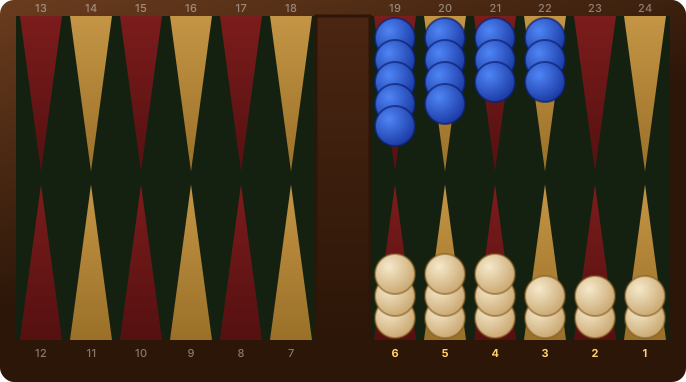
- All fifteen checkers must be home first. You cannot remove a single checker until every one of yours is inside your home board, points 1 through 6.
- A die bears off a checker from the matching point. Roll a 4, and you may remove a checker from your 4-point. Doubles work as usual: four numbers to use.
- Higher numbers bear off from your highest point. If you roll a 6 but your highest occupied point is the 4-point, the 6 may bear a checker off the 4-point. This only applies when no checker sits on a higher point.
- You may move instead of bearing off. Any die can be used to move a checker within your home board rather than removing one, and sometimes that is the right play.
- You must use both dice if legally possible, just as in the rest of the game. The complete movement rules are covered in the full rules guide.
- Getting hit resets the clock. If you leave a blot during the bear-off and your opponent hits it, that checker goes to the bar, must re-enter in your opponent's home board, and must travel all the way around before you may bear off again. This is why contact changes everything.
The first player to bear off all fifteen checkers wins. If the loser has borne off at least one checker, it is a single game; none, and it is a gammon worth double; none plus a checker still on the bar or in the winner's home board, and it is a backgammon worth triple.
Two different games: contact or no contact
Before choosing a bear-off move, ask one question: can I still be hit? If your opponent has an anchor in your home board or a checker on the bar, you are bearing off against contact and safety rules. If every enemy checker has passed yours, it is a pure race and efficiency rules. The two techniques are nearly opposites, and applying the wrong one is a classic leak.
No contact: bear off for speed
With no possibility of being hit, blots do not matter at all. Your only enemy is wasted pips:
- Take checkers off whenever you can. With rare exceptions, removing two checkers beats any move that removes one, and removing one beats removing none. Checkers off the board win games.
- Avoid gaps and deep stacks. When you must move within the board rather than bear off, fill empty points and smooth your distribution so future numbers all do work. A pile of checkers on the 1-point and 2-point wastes the big numbers you roll later.
- Watch the race, not the board. A quick pip count tells you whether you are favored, which matters mostly for the cube.
Against contact: bear off for safety
When your opponent holds an anchor in your home board, one careless roll can turn a winning bear-off into a loss, because a hit checker has the whole track to travel while their home board waits for you. The priorities flip:
- Do not leave a shot. Pass up taking a checker off if doing so leaves a blot the anchor can reach. Slower and safe beats faster and dead.
- Clear from the rear. Strip your highest points first and keep no stragglers behind the enemy anchor. Points cleared cleanly can never cost you later.
- Keep an even distribution. Awkward doubles and big numbers are what force blots. Even, flexible structures let every roll play safely.
- Mind their timing too. Your opponent must eventually run or crunch. Sometimes the best plan is to bear in slowly and let their position collapse first.
The cube in the bear-off
Bear-off races are the sharpest cube situations in backgammon because the equity swings are calculable. In a pure race, your pip lead drives the decision, and close bear-offs reward exact play more than any other phase. If you are not sure when a race is a double, a take, or a pass, the doubling cube guide covers the standard benchmarks. A surprising share of the equity you can gain as an improving player lives right here.
Practice the endgame where it is measured
Bear-off technique is perfect for deliberate practice because every position has a mathematically best play. On Backgammon Battles, the free move-by-move analysis flags every bear-off error and shows the correct play, so wasted pips and unnecessary blots stop being invisible. A week of reviewed endgames tightens your finish noticeably.
Play free ranked matches with provably fair dice, then let the free analysis catch every wasted pip in your bear-off.
Play backgammon freeFrequently asked questions
When can you start bearing off?
Only when all fifteen of your checkers are in your home board. If one is hit during the bear-off, it must re-enter and return home before you can resume.
Do you need an exact roll to bear off?
A die removes a checker from the matching point, and a number higher than your highest occupied point bears off from that highest point. Otherwise you move within your board.
How do you bear off safely against an anchor?
Avoid leaving blots: clear your highest points first, keep an even spread so bad rolls play safely, and skip taking a checker off when it would expose a shot.
Brush up on the complete rules →
© 2026 Backgammon Battles