Backgammon rules
The complete rules of backgammon in one place: setup, movement, hitting, bearing off, the doubling cube, scoring, match play, and the optional rules you will meet in serious games. New to the game? Start with our beginner's guide to playing backgammon.
That is the part this site is for. Every game is rated, and afterwards a computer walks back through your moves and shows you which ones actually cost you. The dice are committed before you move and verifiable after, so the only variable left in the result is you.
Play a rated game freeThe board and setup
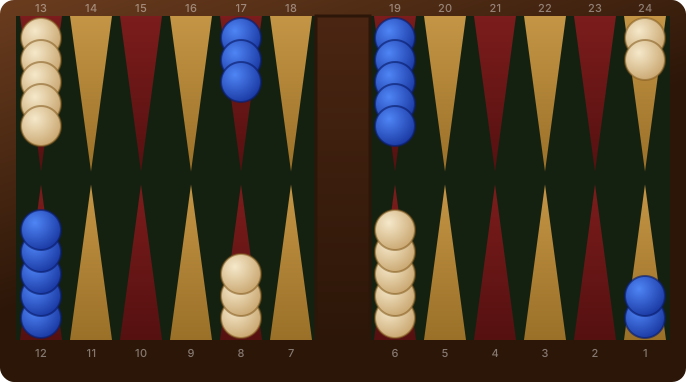
Backgammon is played on a board of 24 points, divided into four six-point quadrants: each player's home board and outer board. Each player has 15 checkers. The two players move in opposite directions toward their own home boards. The standard starting position for each player is two checkers on the 24-point, five on the 13-point, three on the 8-point, and five on the 6-point, mirrored for the opponent.
Object of the game
Move all 15 of your checkers into your home board and bear them all off the board before your opponent does. The first to remove all their checkers wins.
Movement of the checkers
- Roll two dice. Each number is a separate move applied to one checker; you may move two checkers once each, or one checker twice.
- Doubles are played twice over: a roll of 3-3 gives you four 3s.
- You may move to a point that is open, occupied by your own checkers, or occupied by exactly one opposing checker.
- You must use both numbers if a legal play exists. If only one can be played, you must play that one; if either could be played but not both, you must play the larger.
Hitting and entering from the bar
A point with a single checker is a blot. Landing on an opponent's blot hits it and sends that checker to the bar. A player with one or more checkers on the bar must enter them all into the opponent's home board, using the dice, before making any other move. An entering number that lands on an open point or a point with one enemy checker is legal; if no entering number is open, the player forfeits the turn.
Bearing off
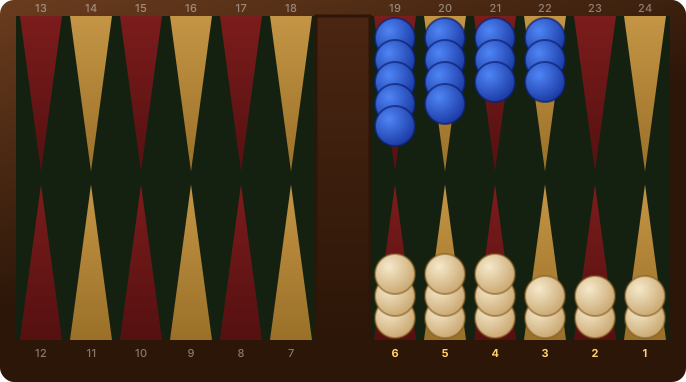
Once all 15 of your checkers are in your home board, you bear off by rolling the number of the point a checker sits on: a 4 bears off a checker from your 4-point, and so on. If you roll a number higher than your highest occupied point, you bear off a checker from the highest point that still has one. You are not required to bear off if a legal in-board move is available with that number. If a checker is hit during bear-off, it goes to the bar and must re-enter and travel home before bearing off can resume.
The doubling cube
The doubling cube tracks the stake, starting at 1. Before rolling on your turn, you may propose to double. Your opponent declines and forfeits the current stake, or accepts and takes possession of the cube, meaning only they may offer the next double (a redouble). There is no limit to the number of redoubles in a game. Two optional cube rules are common: a beaver (the player offered a double may immediately redouble while keeping the cube) and the Jacoby rule (gammons and backgammons count as a single game until the cube has been turned).
Gammons and backgammons
- Single game: the loser has borne off at least one checker. Worth the cube value (1, 2, 4, ...).
- Gammon: the loser has borne off no checkers. Worth double the cube value.
- Backgammon: the loser has borne off none and still has a checker in the winner's home board or on the bar. Worth triple the cube value.
Match play and the Crawford rule
Serious backgammon is played in matches to a target score (commonly 3, 5, 7, or more points). The Crawford rule applies: when either player first reaches a score one point short of the match, the very next game is played without the doubling cube. After that one Crawford game, doubling resumes for the remainder of the match. The Crawford rule prevents the trailing player from doubling immediately out of desperation.
Optional rules
- Automatic doubles: if both players roll the same number on the opening roll, the cube is turned to 2 (often capped at one automatic double).
- Beavers and raccoons: aggressive redoubling options in money play.
- Jacoby rule: gammons and backgammons count single until the cube is turned (money play only, never in match play).
Fair play online
In over-the-board play, fairness depends on honest dice and accurate scoring. Online, that responsibility shifts to the platform. On Backgammon Battles every roll is generated on the server from a cryptographically secure source, independent of either player's device, and the full move history of each game is recorded and replayable, so no client can influence a roll or make an illegal move.
Play ranked matches with the doubling cube and the Crawford rule against real opponents, climb a world ranking, and review every game move by move.
Play backgammon freeFrequently asked questions
What is the Crawford rule?
When a player first reaches a score one point short of winning the match, the next game is played without the doubling cube. After that single game, doubling is allowed again for the rest of the match.
How does the doubling cube work?
Before rolling on your turn you may offer to double the stakes. Your opponent accepts, taking ownership of the cube so only they can make the next double, or declines and forfeits the current stake. The cube can be redoubled later.
What is a gammon and a backgammon?
A gammon is a win worth double, when the loser has borne off no checkers. A backgammon is a win worth triple, when the loser has borne off none and still has a checker in the winner's home board or on the bar.
New to backgammon? Start with the beginner's guide →
© 2026 Backgammon Battles