How to play backgammon
Backgammon is one of the oldest games in the world, and one of the most rewarding: a two-player race where every roll is a small puzzle and the better player wins far more often than not. Here is everything you need to start playing.
The board sets itself up, the rules are enforced for you, and you are matched with a real opponent at your level. Ranked play, tournaments, and a computer review of every game.
Play free nowThe goal
Backgammon is a race. Each player has 15 checkers, and your job is to move all of them around the board into your own home board and then bear them off (remove them from the board). The first player to bear off all 15 checkers wins the game.
Setting up the board
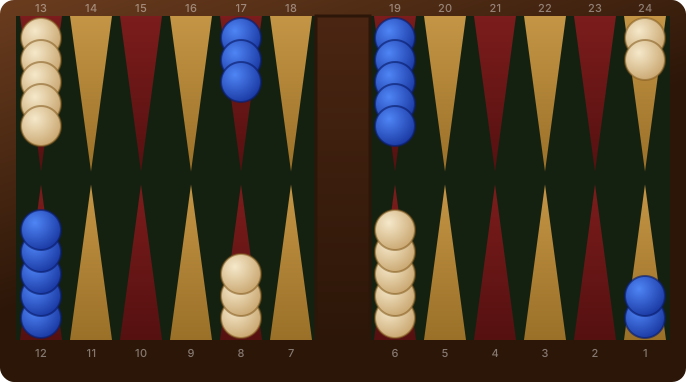
The board has 24 narrow triangles called points, split into four quadrants of six. The two players move in opposite directions, each toward their own home board. The standard starting position for each player is:
- 2 checkers on your 24-point (farthest from home)
- 5 checkers on your 13-point
- 3 checkers on your 8-point
- 5 checkers on your 6-point
Your opponent's checkers mirror yours on the opposite side. Online, the board sets itself up for you, so you can skip straight to playing.
Taking a turn
On your turn you roll two dice. Each die is a separate move: a roll of 5 and 3 lets you move one checker five points and another three points, or move a single checker eight points in two steps. You always move toward your home board, and you may only land on a point that is open, has your own checkers, or has exactly one opposing checker.
Roll doubles and you get four moves instead of two: a roll of 4-4 means you play four 4s. You must use both dice if there is any legal way to do so.
Hitting and the bar
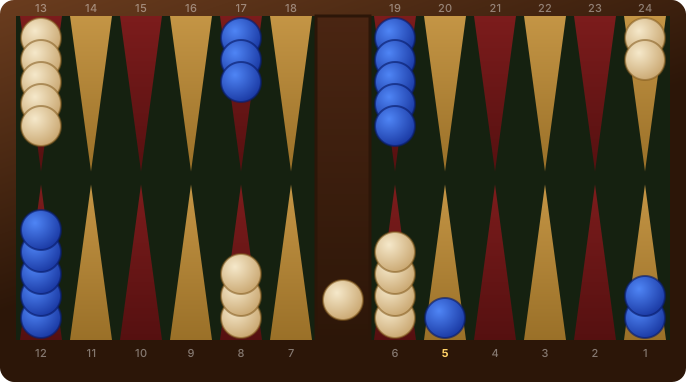
A point holding a single checker is called a blot, and it is vulnerable. If you land on your opponent's blot, you hit it: their checker is removed and placed on the bar in the middle of the board. A player with a checker on the bar must re-enter it into the opponent's home board on their next roll before making any other move. If they cannot enter, they forfeit the turn. Hitting is one of the most powerful weapons in the game, because it sends an opponent's checker all the way back to the start.
Bearing off
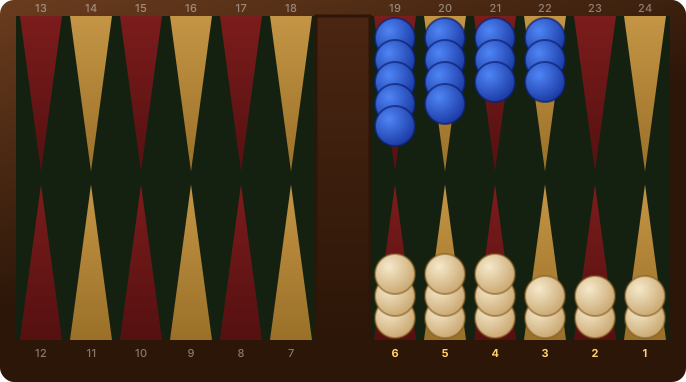
Once all 15 of your checkers have reached your home board (your last six points), you can begin bearing off: using your dice rolls to remove checkers from the board. A roll of 6 bears off a checker from your 6-point, a 5 from your 5-point, and so on. The first player to bear off all 15 checkers wins. Warning: if one of your checkers gets hit while you are bearing off, it goes to the bar and must travel all the way home again before you can continue.
The doubling cube
The doubling cube is backgammon's signature twist and the reason it rewards skill so heavily. At the start of any turn, before you roll, you can offer to double the stakes. Your opponent either accepts (and play continues for double the points) or declines (and forfeits the current stake). Knowing when to double, and when to accept, is half of expert backgammon.
Winning: single, gammon, and backgammon
- Single game: your opponent has borne off at least one checker: worth 1 point.
- Gammon: your opponent has borne off none: worth 2 points.
- Backgammon: your opponent has borne off none and still has a checker in your home board or on the bar: worth 3 points.
Multiply by the doubling cube and a single game can swing a match.
A few tips to start winning
- Avoid leaving blots where your opponent can hit them.
- Make points, especially in your home board, to block your opponent's escape.
- When you are ahead in the race, run; when you are behind, hold back and play for a hit.
- Learn the doubling cube early. It is where good players take their edge.
Reading the rules only takes you so far. Play ranked matches against real opponents at your level, climb a world ranking, and get the computer's review of every game.
Play backgammon freeFrequently asked questions
Is backgammon hard to learn?
No. The basics take about five minutes: roll two dice, move your checkers toward your home board, and bear them all off before your opponent. The depth comes from strategy and the doubling cube, which you pick up as you play.
Is backgammon luck or skill?
Both, but over a match skill dominates. The dice are random, yet the stronger player wins consistently through better checker play, cube decisions, and risk management. That is why competitive backgammon is ranked.
How long does a game take?
A single game is usually five to fifteen minutes. Multi-point matches take longer and are how serious players compete.
Read the complete backgammon rules →
© 2026 Backgammon Battles