The best backgammon opening moves
Your very first roll sets the tone of the game, and unlike most positions there are only fifteen possible opening rolls, so the best plays are well known. This is a roll-by-roll reference for the strongest opening move on each, with the reasoning. Notation uses the standard "from point / to point" (for example 8/5 means move a checker from your 8-point to your 5-point). New to the board? Start with how to play backgammon.
Play rated matches against real opponents, then read the computer's verdict on every decision you made. Your performance rating moves on how well you played, not on whether the dice went your way, which is the only honest way to measure improvement.
Put it into practiceThe three best openers (point-makers)
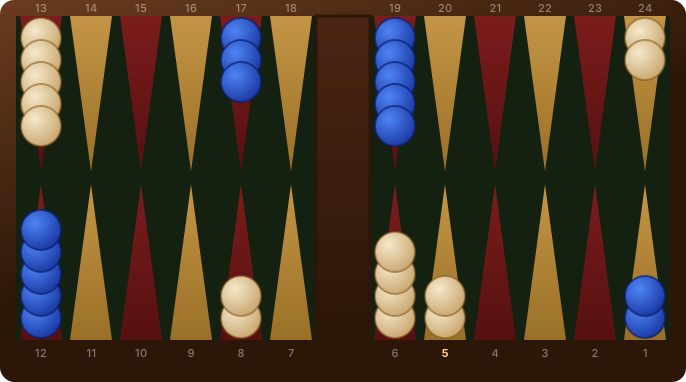
Four rolls let you immediately make a valuable point with no blot left behind. These are the cleanest, strongest opening plays in the game:
- 3-1:
8/5 6/5, make your 5-point. The single best opening roll. The 5-point is the most valuable point on the board, and you take it with no risk. - 4-2:
8/4 6/4, make your 4-point. A strong, safe inner-board point. - 6-1:
13/7 8/7, make your bar-point (the 7-point). Excellent for building a prime in front of your opponent's back checkers. - 5-3:
8/3 6/3, make your 3-point. Solid, though slightly deeper than ideal; still a clear point-making play.
When you roll one of these, play it without thinking twice.
The big runner: 6-5
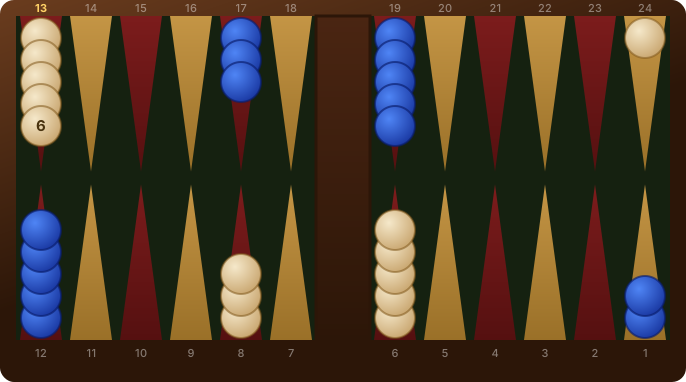
6-5: 24/13, the famous "lover's leap." You run a single back checker all the way to the safety of your midpoint in one move, escaping your opponent's home board entirely. It is the standard, undisputed play for 6-5.
The splitting and building rolls
The remaining opening rolls cannot make a point, so the goal is to develop: bring down builders toward the points you want to make next, or split your back checkers to fight for an advanced anchor. The plays below reflect modern computer rollouts. Where two plays are close, the table notes it.
| Roll | Recommended play | Idea |
|---|---|---|
| 2-1 | 13/11 24/23 | Split the back checkers and bring down a builder (the common modern play). Slotting 13/11 6/5 is a sharper alternative. |
| 4-1 | 13/9 24/23 | Builder down plus a small split. |
| 5-1 | 13/8 24/23 | Safe builder to the 8-point, plus a split. |
| 3-2 | 24/21 13/11 | Split to the 21-point and bring down a builder. |
| 5-2 | 13/8 13/11 | Two checkers down to build (the "two down" play). |
| 6-2 | 24/18 13/11 | Advance a back checker to the edge of the outfield plus a builder. |
| 4-3 | 24/20 13/10 | Split to the golden 20-anchor point plus a builder. |
| 6-3 | 24/18 13/10 | Run to the bar-point edge plus a builder. |
| 5-4 | 24/20 13/8 | Split to the 20-point and make a safe builder play. |
| 6-4 | 24/18 13/9 | Advance a back checker plus a builder. Running 24/14 is a reasonable alternative. |
These are sound, widely accepted plays for money and casual games. At specific match scores (for example when a gammon matters more or less), the best play can shift slightly, but you will never go far wrong with the moves above.
Why the 5-point matters so much
Notice how many of the best plays revolve around the 5-point and the points near it. That is no accident: the 5-point and bar-point form the front of a prime that traps your opponent's back checkers, and an advanced anchor on your opponent's 20-point keeps you safe when you fall behind. Almost every opening decision is really a question of which of these key points you are fighting for. For the bigger picture, see our backgammon strategy guide.
Learn your openings by playing
Memorizing a table is a start, but the openings stick when you play them and see how each game unfolds. On Backgammon Battles, every match is analyzed move by move, so if you misplay an opening the computer shows you the stronger move and what it was worth. Play, get graded, and the right openings become second nature.
Ranked matches, fair random dice, and move-by-move analysis that catches your opening mistakes. Free to play.
Play backgammon freeEvery opening roll, one page each
There are fifteen possible opening rolls, and they are not equally interesting. Four have an answer nobody argues with. Some have an answer that changed once computers could roll out a position a million times. One is still contested. Each has its own page with the board position, the reasoning, and an honest statement of how settled the answer actually is.
The four you should never think about
Three rolls make a point outright and one runs a checker to safety. Every reference agrees on all four, so learn them and spend your thinking time elsewhere.
- 3-1 — 8/5 6/5Make the 5-point. Every source agrees.
- 4-2 — 8/4 6/4Make the 4-point. Every source agrees.
- 6-1 — 13/7 8/7Make the bar point. Every source agrees.
- 6-5 — 24/13Lover's Leap. Every source agrees.
The rolls with a real decision
Here the answer depends on what you are trying to do. These are the rolls where the pre-computer textbooks were sometimes wrong, and where the score changes the right play.
- 5-3 — 8/3 6/3Make the 3-point. The computers changed the old answer.
- 2-1 — 13/11 24/23Split, or slot the 5-point. Rollouts are close.
- 5-1 — 24/23 13/8Split and bring one down. The computers changed the old answer.
- 4-1 — 24/23 13/9Split and build. The computers changed the old answer.
- 5-2 — 13/8 13/11Two down, or split. Rollouts are close.
- 3-2 — 13/11 13/10Two builders, or split. Rollouts are close.
- 4-3 — 13/10 13/9Builders or anchor. Rollouts are close.
- 5-4 — 24/20 13/8Toward the golden anchor. The computers changed the old answer.
Where the experts still argue
Rolls where rollouts are close enough that confident advice should make you suspicious. Understanding why they are close is worth more than memorising an answer.
- 6-2 — 24/18 13/11Run or split. Rollouts are close.
- 6-3 — 24/18 13/10Run to the 18-point. The computers changed the old answer.
- 6-4 — 24/18 13/9The genuinely contested one. Still genuinely contested.
Frequently asked questions
What is the best opening roll?
3-1 is widely considered the best, because 8/5 6/5 makes your 5-point, the most valuable point on the board, with no risk.
How should I open with 3-1?
Play 8/5 6/5 to make your 5-point. It is one of the few opening plays that every expert and every computer agrees on.
Should I split or slot?
Modern rollouts generally favor splitting your back checkers or bringing down builders over slotting a key point. The splitting and building plays above are safe, strong defaults.
Read the full strategy guide →
Then master the doubling cube →
© 2026 Backgammon Battles