Backgammon strategy: from beginner to winning player
Backgammon looks like a dice game, but the player who understands a handful of strategic ideas wins far more often than the one who just moves checkers. This guide covers the concepts that actually move the needle: which points to make, how to build a prime, when to defend with an anchor, when to race, when to hit, and the one skill that separates good players from great ones. If you are brand new, start with our beginner's guide first.
Play rated matches against real opponents, then read the computer's verdict on every decision you made. Your performance rating moves on how well you played, not on whether the dice went your way, which is the only honest way to measure improvement.
Put it into practiceMake valuable points, especially the 5-point
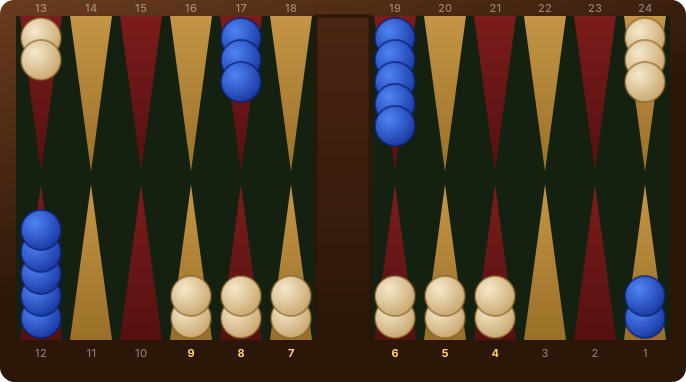
The single most useful thing you can do early is make your own 5-point (the "golden point"). It blocks your opponent's back checkers, anchors your home board, and gives you a base to build from. Right behind it are your bar-point (the 7-point) and 4-point. As a rule, making a strong point usually beats grabbing a few extra pips, because points are permanent and pips are not.
Build a prime to trap back checkers
A prime is a wall of consecutive made points. Your opponent cannot jump a checker over six points in a row, so a full six-prime traps any checker behind it until your wall breaks. You rarely build a full prime, but even a four or five-point block in front of your opponent's back checkers is enormously powerful: it buys you time and forces them to sit and wait. Building and maintaining a prime is one of the most reliable ways to win.
Keep an anchor when you are behind
When the race is going against you, do not panic and run; hold an anchor, a made point in your opponent's home board (the 20-point "golden anchor" is ideal). An anchor means you can never be shut out, it gives you shots at your opponent's blots as they try to come home, and it keeps a losing game alive. Patient defense with a good anchor turns many lost-looking games around.
Know when to race and when to fight
Count the pips. If you are clearly ahead in the race, simplify: break contact, avoid unnecessary blots, and run for home. If you are behind, do the opposite: keep contact, hold your anchor, and play for a hit, because a race you are losing only gets worse. Recognizing which game you are in, the race or the contact game, is half of good checker play.
Hit with a purpose
Hitting an opponent's blot sends it to the bar and costs them time, but a hit that leaves you exposed can backfire. Good hits do one of two things: they gain real ground in the race, or they pick up tempo while you are building your board. Hitting deep in your home board when your board is strong is excellent, because a checker on the bar may struggle to re-enter. Hitting loosely just to hit, when it scatters your own checkers, often is not worth it.
Bear off cleanly
If there is no contact, just take checkers off as efficiently as you can and avoid wasting pips. If your opponent still has an anchor in your home board, be careful: clear from the back, do not leave a blot they can hit, and take an early, safe position over a greedy one. Many won games are thrown away by a careless shot during the bear-off.
The doubling cube wins matches
Here is the truth most casual players miss: the biggest source of points you are leaving on the table is the doubling cube, not your checker play. Knowing when to double, and when to take or drop, is pure judgment and the fastest skill to improve. We cover it in depth in our guide to the doubling cube, and it is the first thing we would tell any improving player to study.
The fastest way to improve
Reading helps, but nothing improves your game like reviewing your own play. A backgammon engine can compare every move and cube decision you made to the best available and show you exactly where, and by how much, you went wrong. On Backgammon Battles every match is analyzed move by move, so your blunders stop being invisible. Play, review, fix one leak at a time, and your rating climbs.
Play ranked matches against real opponents, get every game graded by the computer, and climb a transparent world ranking. Free to play.
Play backgammon freeFrequently asked questions
What is the best strategy in backgammon?
It depends on the position, but the core principles are: make valuable points (especially the 5-point and bar-point), build a prime, keep an anchor when behind, race when ahead, and use the cube to win more when winning.
What is the most important point?
The 5-point. Making your own 5-point blocks your opponent and anchors your board; making your opponent's 5-point is the best defensive anchor when you are behind.
How do you get better at backgammon?
Play a lot and review your games with computer analysis. Focus first on the doubling cube, then on making key points and avoiding loose blots. Studying your own mistakes beats memorizing rules.
The best opening moves, roll by roll →
© 2026 Backgammon Battles