How to set up a backgammon board
Every backgammon game starts from the same position, and once you have set it up a few times it takes about thirty seconds. Here is the starting position point by point, how the points are numbered, which way the checkers travel, and the setup mistakes that trip up beginners most often.
That is the part this site is for. Every game is rated, and afterwards a computer walks back through your moves and shows you which ones actually cost you. The dice are committed before you move and verifiable after, so the only variable left in the result is you.
Play a rated game freeThe board at a glance
A backgammon board has 24 narrow triangles called points, arranged in four quadrants of six points each. A raised ridge down the middle, the bar, divides the board in half. Each player has fifteen checkers of one color, two dice, and a shared doubling cube that starts in the middle showing 64.
From your seat, the four quadrants are: your home board (points 1 to 6), your outer board (points 7 to 12), your opponent's outer board (points 13 to 18), and your opponent's home board (points 19 to 24). Points are numbered from each player's own perspective, so your 1-point is your opponent's 24-point. Both home boards sit on the same side of the bar, facing each other. By tradition that side is the one nearest the light, but in casual play either side works as long as both players agree.
The starting position, point by point
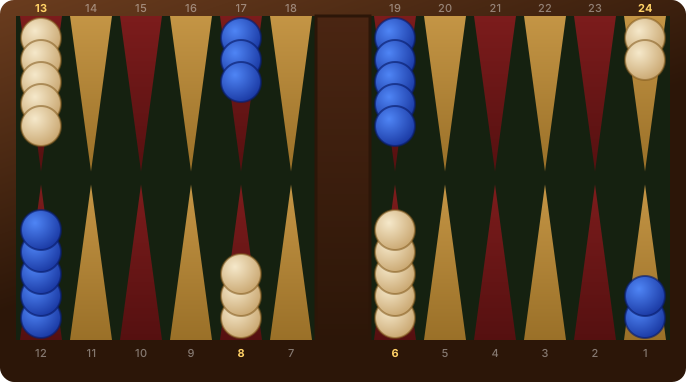
Each player sets up their fifteen checkers like this, counting from their own perspective:
- 2 checkers on the 24-point. These are your back checkers, deep in your opponent's home board. They have the farthest to travel.
- 5 checkers on the 13-point. This is your midpoint, a key staging area in your opponent's outer board.
- 3 checkers on the 8-point. Your 8-point sits in your own outer board, two points outside your home board.
- 5 checkers on the 6-point. The biggest stack, already inside your home board and ready to build blocking points.
Your opponent does exactly the same from their side. Because each player's 24-point is the other player's 1-point, the finished setup is perfectly symmetrical: every stack of yours faces an identical enemy stack across the board. If the board does not look mirrored when you finish, something is off.
Which way the checkers move
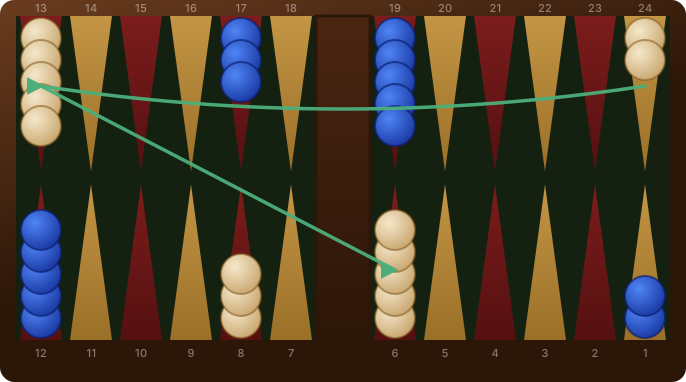
Both players move from higher numbers to lower numbers from their own point of view: from the 24-point, around through the outer boards, into the home board, and finally off the board. That means the two armies travel in opposite directions around a horseshoe-shaped track, passing through each other along the way. All that contact in the middle is where hitting, blocking, and most of the game's drama happens. If you are brand new to the rules of movement, hitting, and bearing off, start with our guide on how to play backgammon.
Common setup mistakes
A few errors come up again and again with new players:
- Swapping the 8-point and 13-point stacks. Remember: the stack of five goes on the midpoint (13), and the stack of three goes on the 8-point. A handy check: on each half of the board, every player has exactly one tall stack of five.
- Back checkers in the wrong corner. Your two back checkers start on your 24-point, which is the point farthest from your home board, directly behind your opponent's biggest stack.
- Both players moving the same direction. If your checkers and your opponent's are flowing the same way, one side is set up backwards. The two sides must move toward opposite ends.
- Home boards on opposite sides of the bar. Both home boards belong on the same half of the board. If you bear off to the right, your opponent bears off to their right too, which is the same physical side.
- Miscounting a stack. It is easy to put four checkers where five belong. Count 2, 5, 3, 5 for each color before the first roll.
A quick way to verify the setup
There is a neat arithmetic check. In a correct starting position, each player's pip count, the total distance all fifteen checkers must travel to bear off, is exactly 167: two checkers times 24, plus five times 13, plus three times 8, plus five times 6. If you ever want certainty that a physical board is set up right, that number settles it.
Once the board is set, each player rolls one die. The higher roll goes first and plays both numbers shown, and from there the full rules take over. It is worth learning the strongest replies to that first roll early, since the opening moves are one of the few parts of backgammon with a known best answer.
Or skip the setup entirely
One quiet advantage of playing online: the board sets itself up, every time, with zero mistakes. On Backgammon Battles you go from "I want to play" to your first roll in seconds, against real opponents or a practice bot, and every game comes with free move-by-move computer analysis afterward so you can see exactly where you played well and where you slipped.
Play ranked matches with provably fair dice and free move-by-move analysis of every game. No downloads, no setup errors.
Play backgammon freeFrequently asked questions
How do you set up a backgammon board?
Each player places 2 checkers on their 24-point, 5 on their 13-point, 3 on their 8-point, and 5 on their 6-point. The two setups mirror each other, and both home boards sit on the same side of the bar.
Which direction do the checkers move?
Each player moves from their 24-point toward their 1-point, from higher numbers to lower from their own perspective. The two players travel in opposite directions toward their own home boards.
How many checkers go on each point at the start?
Two on the 24-point, five on the 13-point, three on the 8-point, and five on the 6-point, for fifteen checkers per player. A correct setup gives each side a starting pip count of 167.
Learn how to play, start to finish →
© 2026 Backgammon Battles