Backgammon pieces and dice: how many, and why it matters
Backgammon is a game for two players. Each player has fifteen checkers, so there are thirty on the board, plus a pair of dice and a dice cup for each side and one doubling cube that both players share. Of everything in the box, the dice are the piece that decides whether the game is fair, which is why tournament rules spend more words on how they are thrown than on anything else.
That is the part this site is for. Every game is rated, and afterwards a computer walks back through your moves and shows you which ones actually cost you. The dice are committed before you move and verifiable after, so the only variable left in the result is you.
Play a rated game freeWhat comes in a backgammon set
Every full set contains the same equipment, whether it is a travel board or a leather tournament case:
| Piece | How many | What it is for |
|---|---|---|
| Board | One | Twenty-four narrow triangles called points, in four quarters of six, split down the middle by the bar. |
| Checkers | Fifteen per player | The pieces you race around the board and bear off. Also called counters, men or stones. |
| Dice | Two per player | Each player rolls their own pair. Only one pair is ever in play at a time. |
| Dice cups | One per player | The dice are shaken and thrown from the cup, never rolled from the hand. |
| Doubling cube | One, shared | A larger die marked 2, 4, 8, 16, 32 and 64 that records the stakes of the game. |
A cheap set and an expensive one play identically. What you pay for in a good set is mostly better dice and cups, for reasons that become obvious further down this page.
Fifteen checkers each, and where they start
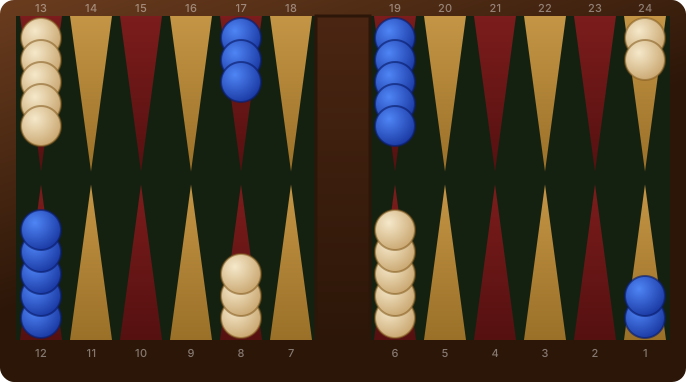
Each side's fifteen checkers begin spread across four points: two on the 24-point, which is deep in the opponent's home board, five on the 13-point, three on the 8-point and five on the 6-point. The two armies mirror each other and travel in opposite directions around the same horseshoe, which is why they collide in the middle of the board and why hitting is possible at all. Our page on how to set up a backgammon board goes through the starting position point by point and gives a quick way to check you have it right.
Why fifteen? Nobody can say with certainty where the number came from, but it is easy to see what it does. Fifteen checkers is enough to build a wall of six consecutive points and still have spares to bring around behind it, and few enough that every checker matters when the race to bear off arrives. Variants change the count to change the game: hypergammon gives each player only three checkers, and nackgammon keeps fifteen but starts four of them further back. The variants page covers both.
Online, you never count checkers. The board is set up for you, and a checker cannot go missing between games, which removes the oldest dispute at a kitchen table.
How many players: two, or a chouette
Backgammon is strictly head to head. Every rule, from the opening roll to the doubling cube, assumes two players with opposite interests. When more people want to play at once, the traditional answer is a chouette. One player, the box, plays a single board against everyone else. The team's captain rolls and moves for them, the other team members can advise and often hold their own doubling cubes, and after each game the seats rotate so everyone gets a turn in the box and a turn as captain.
A chouette is a social format rather than a different game: the board, the checkers and the moves are exactly the same. If you want more than one opponent without a chouette, the online answer is simpler. Play several games at once, or play correspondence games with a move a day each.
Two pairs of dice and the doubling cube
It surprises newcomers that a set has four dice when a roll only uses two. Each player keeps their own pair and their own cup, and rolls only those. That is partly etiquette and partly fairness: nobody handles the dice the opponent is about to throw.
The fifth die-shaped object is not a die at all. The doubling cube is never rolled. It sits in the middle at the start of the game with the 64 face showing, which by convention means the stakes are one, and a player who thinks they are winning can offer to double the stakes before their roll. It is where most of the skill in money backgammon lives, and it is also unrelated to rolling a double on the dice, which is a separate rule covered in the doubles rules.
Why the dice get the strictest rules
Every other piece of equipment is passive. Checkers do not move themselves and the cube only records a number. The dice are the only thing on the table that produces information neither player controls, and a game that mixes skill with chance only works if the chance is real. Physical dice can fail that test in three ways: the dice themselves can be uneven, the throw can be controlled, and the result can be argued about. Tournament rules address all three.
- Precision dice. Ordinary dice have rounded corners and drilled pips that can leave them very slightly unbalanced. Precision dice have sharp edges and pips filled flush with paint of matching weight, so each face is as close to equally likely as manufacturing allows. US tournament rules have long let either player ask for precision dice when the director has approved them.
- Lipped cups and baffle boxes. A cup with a ridge around the inside of the rim stops a practised hand from sliding the dice out in a controlled way, because the dice have to tumble over the lip. A baffle box goes further: the dice are dropped into a box with internal ramps and land without anyone touching the throw. The US federation's 2024 draft rules let each player choose a cup or a baffle box.
- The cocked dice rule. Both dice must come to rest flat on the board to the right of the bar. A die that lands tilted against a checker, on the bar or off the board is cocked, and both dice are thrown again. In a tournament you wait for your opponent to agree that a die is cocked before picking it up, because a player who rerolls first will usually lose the dispute.
Every one of these rules exists because someone, somewhere, had a reason to doubt a roll. None of them can prove a roll was fair after the fact. They narrow the ways it could have been unfair.
What replaces the dice cup online
An online game has no cup, no lip and no table edge, so the question becomes who generates the numbers and whether anyone could change them. On Backgammon Battles the answer is designed so you do not have to trust us. Rolls are generated on the server from a cryptographically secure random source, never on your device or your opponent's. The server commits to its random seed before play, so it cannot pick a different sequence after seeing the position. And every completed game is stored and replayable roll by roll from your history. Our page on how the dice are proven fair goes through each step, and is online backgammon rigged? covers why fair dice still feel streaky.
That is the online equivalent of precision dice and a baffle box, with one improvement: you can check the result afterwards instead of only trusting the process.
Equipment for playing for something
A set at home usually comes with an argument about what the game is played for. The doubling cube was invented to raise the stakes, and the stakes are what make cube decisions matter. Online you can play for Battle Bucks, a play currency that makes each game count without any real money involved, and every rated game feeds a performance rating that measures how well you moved rather than how the dice fell.
Start as a guest, play a rated game, then replay it roll by roll.
Play backgammon freeFrequently asked questions
How many pieces does each player have in backgammon?
Fifteen each, so thirty checkers on the board in total. Each player's fifteen start on four points: two on the 24-point, five on the 13-point, three on the 8-point and five on the 6-point.
How many players can play backgammon?
Backgammon is a two-player game. Larger groups play a chouette, where one player sits in the box against a team, a captain moves for the team, and players rotate after each game.
How many dice do you need for backgammon?
A standard set has two pairs of dice, one pair for each player, plus a doubling cube marked 2, 4, 8, 16, 32 and 64. Each player rolls their own pair from their own cup.
What happens if a die lands cocked or off the board?
Both dice must land flat on the board to the right of the bar. If either die is cocked, lands on a checker at an angle, or leaves that half of the board, both dice are rolled again. In tournaments you should wait for your opponent to agree the roll is cocked before rerolling.
Are the dice fair when you play backgammon online?
On Backgammon Battles every roll is generated on the server from a cryptographically secure source, the seed is committed before play so it cannot be changed afterwards, and every game can be replayed roll by roll from your history.
© 2026 Backgammon Battles