The race cube: when to double, take or pass in a backgammon race
In a pure backgammon race, cube decisions come from an adjusted pip count, not from feel. The quick method is the 8-9-12 rule: double with a lead of about 8 percent, redouble with about 9, take while behind by no more than 12. The better method is the Keith count, which adds pips for stacked and gappy checkers, gives the player on roll a one-seventh adjustment, and then compares the two totals against fixed margins.
Races are the part of the game where a formula comes closest to the right answer, which makes them the cheapest cube errors to stop making. Most players know their pip count is supposed to matter. Fewer know what to do with it once they have it, and almost nobody adjusts it for the shape of the position, which is where the large mistakes hide.
What counts as a pure race
A race begins when no checker of either side still has to pass an opposing checker. Nobody can be hit again, nobody can be blocked, and the game reduces to one question: who gets fifteen checkers home and off first. Everything on this page applies only there. If one back checker is still waiting on an anchor, the position is a holding game, and racing formulas will mislead you, sometimes badly.
A race is also the one stage where the cube is offered and refused without much drama, because both players can see the whole future in rough outline. That clarity cuts both ways: a passed double in a race is often a gift from an opponent who forgot to adjust.
Why the raw pip count is not enough
The pip count tells you how far your checkers have to travel. It does not tell you how many rolls the trip will take, and rolls are what you actually spend. Two things push the real number up.
- Wastage. Checkers piled on your lowest points waste pips in the bear-off. A 6 rolled when your only checkers are on the 1-point still takes one checker off, so five of those six pips are thrown away.
- Gaps. Empty high points in your home board mean some rolls cannot bear off a checker cleanly, and you move inside the board instead of taking one off.
Being on roll matters too. A roll of two dice moves a checker a little over 8 pips on average once doubles count four times, which is how the doubles rule works out across all 36 rolls. The player about to roll is in effect that far ahead before anything else is counted. Every good race method builds in some allowance for it.
The quick method: the 8-9-12 rule
Count both sides and work out your lead as a percentage of your own count, as the player on roll.
- Double with a lead of about 8 percent or more.
- Redouble with a lead of about 9 percent or more.
- Take if the doubler's lead is no more than about 12 percent. Beyond that, pass.
Suppose you are on roll needing 100 pips and your opponent needs 110. Your lead is 10, which is 10 percent of 100: enough to double, enough to redouble, and comfortably inside the take window, so the answer is double and take. Move your opponent back to 115 and the lead becomes 15 percent, past 12, so now it is double and pass.
The rule is quick, it is easy to remember at the table, and in smooth positions it is usually close. Its weakness is built in: it reads only the pip count, so two positions with the same counts get the same verdict however differently the checkers are stacked.
The accurate method: the Keith count, step by step
Tom Keith, who also built the bkgm.com archive many players learned from, designed his count specifically for race cube decisions and published it with a comparison against older pip-adjusting formulas, including Edward Thorp's. It takes longer than 8-9-12, but every step is simple addition.
- Count pips for both sides as normal.
- Add 2 for each checker beyond the first on the 1-point.
- Add 1 for each checker beyond the first on the 2-point.
- Add 1 for each checker beyond the third on the 3-point.
- Add 1 for each empty point among the 4, 5 and 6 points.
- The player on roll adds one-seventh of their adjusted count, rounded down. This is the allowance for being on roll.
Now compare the on-roll player's final count with the opponent's adjusted count:
- Double if your count exceeds your opponent's by no more than 4.
- Redouble if it exceeds theirs by no more than 3.
- Take if the doubler's count exceeds the taker's by at least 2. If the gap is smaller than 2, or the doubler's count is lower, pass.
The direction trips people up the first time: a count is a distance still to travel, so a lower count is better. "Your count exceeds your opponent's by no more than 4" means you are not too far behind after the adjustments, not that you are ahead.
A worked example: level on pips, not level on shape
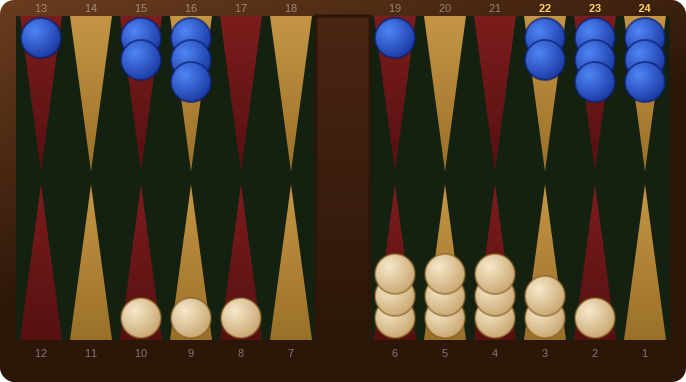
Cream is on roll. Cream's position is smooth: three checkers each on the 6, 5 and 4 points, two on the 3-point, one on the 2-point, and stragglers on the 8, 9 and 10 points. Blue has rushed checkers in and stacked them deep: three on each of its own 1 and 2 points, two on its 3-point, one on its 6-point, nothing on its 4 or 5 points, and six checkers still outside its home board. Both sides need 80 pips.
By the 8-9-12 rule there is nothing to discuss. Cream's lead is zero, nowhere near 8 percent, so no double.
The Keith count sees something else. Cream's shape costs nothing: no extra checkers on the 1 or 2 points, only two on the 3-point, and all of the 4, 5 and 6 points covered. Cream stays at 80, then adds one-seventh for being on roll, 11 rounded down, for 91. Blue's shape is expensive: two extra checkers on the 1-point add 4, two extra on the 2-point add 2, and the empty 4 and 5 points add 1 each. Blue's adjusted count is 88.
Cream's 91 exceeds blue's 88 by 3. That is within 4, so cream doubles. The doubler's count exceeds the taker's by at least 2, so blue takes. Double and take, in a position the raw count calls dead level.
We have not rolled this position out with an engine, so treat both verdicts as estimates. The point of the example is the direction, not the decimal: blue's checkers are stacked where they will waste pips, and a method that cannot see that will hand away doubles every time it happens.
Where formulas stop
- Match play. Both methods were built for money play. Near the end of a match the score moves the take point, and match equity overrides any race formula.
- Gammons. If one side has not borne off a checker and still has stragglers far away, a gammon is possible and the formulas, which ignore gammons, understate the doubler.
- Very short races. With a handful of checkers left each, exact bear-off tables and counting the rolls directly beat any formula.
- Close calls. When a count lands exactly on a threshold, the decision is close, and the cost of getting it wrong either way is small. Spend your attention on the positions far from the line that you get wrong.
Turning the formula into a habit
The value of a race formula comes from using it every single time the contact breaks, not just when the position looks interesting. Count, adjust, compare, then decide. After a few dozen races you will start to see the adjustments without counting them: a stack on the ace point will look like the lost tempo it is.
The fastest way to find out whether the habit has stuck is to have every decision checked. Race cube errors show up clearly in a computer review, because the engine's verdict in a race is about as reliable as it gets, so they are the first thing a performance rating will catch and the first thing it will reward you for fixing. For the doubler's side in every other kind of position, start with when to double, and for counting faster at the table, how to count pips.
Play a rated game against a person, and the review afterwards marks every cube decision, races included, with your error rate at the end. Fair dice you can verify, and nothing to install.
Play a rated game freeFrequently asked questions
What is the 8-9-12 rule in backgammon?
A rule of thumb for cube decisions in a pure race, measured as a percentage of the pip count of the player on roll. Double with a lead of about 8 percent, redouble with about 9 percent, and the opponent can take as long as the lead is no more than about 12 percent. It is quick, but it ignores how the checkers are arranged.
How does the Keith count work?
Start with each side's pip count. Add 2 for every checker beyond the first on the 1-point, 1 for every checker beyond the first on the 2-point, 1 for every checker beyond the third on the 3-point, and 1 for each of the 4, 5 and 6 points that is empty. Then add one-seventh of the player on roll's adjusted count, rounded down. Double if your adjusted count exceeds your opponent's by no more than 4, redouble if by no more than 3, and the opponent should take if the doubler's adjusted count exceeds the taker's by at least 2.
Which race formula is more accurate?
The Keith count, in general, because it adjusts for stacked checkers and gaps that waste pips during the bear-off, which a plain percentage rule cannot see. Neither formula is exact. A computer rollout is the real answer for any specific position, and close positions near either threshold are the ones where formulas disagree.
Does the Keith count work in match play?
It was designed for money play, where only the final score of each game matters. In a match, the score changes the take point and the value of the cube, so near the end of a match a formula built for money play can point the wrong way. Treat it as the starting estimate and adjust for the score.
© 2026 Backgammon Battles