Simple backgammon rules: the whole game in ten rules
Backgammon is a race for two players. You roll two dice, move your fifteen checkers around the board by those numbers, knock your opponent's lone checkers back to the start when you land on them, and win by being the first to bring all fifteen home and take them off the board. The ten rules below are the entire game; everything else is either optional or strategy.
That is the part this site is for. Every game is rated, and afterwards a computer walks back through your moves and shows you which ones actually cost you. The dice are committed before you move and verifiable after, so the only variable left in the result is you.
Play a rated game freeWhy a short version exists
The complete rulebook covers the doubling cube, match scoring, the Crawford rule and a handful of tournament procedures, and a beginner reading it in one sitting tends to give up before the first roll. None of that is needed to play a correct game. What follows is the smallest set of rules that, followed exactly, produces a legal game from the first throw to the last checker. When you want the rest, our full page of backgammon rules has every one of them, including the optional ones.
Rule 1: two players, fifteen checkers each
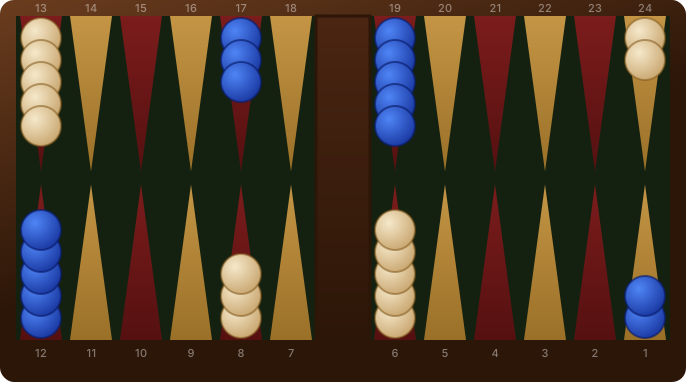
Each player has fifteen checkers of one colour. They start on four points: two on the 24-point, five on the 13-point, three on the 8-point and five on the 6-point, numbered from your own side, with your opponent's set up as a mirror image. The board has twenty-four narrow triangles called points, in four quarters of six. The quarter where your five-checker stack sits on the 6-point is your home board.
Rule 2: race everything home, then take it off
You move from your 24-point towards your 1-point, and your opponent moves the opposite way around the same track. The goal is to bring all fifteen of your checkers into your home board and then remove them, which is called bearing off. The first player with no checkers left wins.
Rule 3: the higher single die moves first
To start, each player rolls one die. The higher number moves first and plays both of the dice already on the board as the first move; a tie is rolled again. After that, players take turns rolling both of their own dice. Our page on how to start a backgammon game covers the opening roll in detail, including the house rule many families play by mistake.
Rule 4: each die is a separate move
A roll of 5-3 is not a single move of eight. It is a move of five and a move of three, which you can give to two different checkers or to the same checker one after the other. If one checker takes both, the point it lands on after the first number must be legal too. This is the rule that makes backgammon a game of choices rather than a counting exercise.
Rule 5: doubles are played four times
When both dice show the same number, you play that number four times. A roll of 6-6 is four moves of six. The doubles rules page covers the details, including what happens when only some of the four can be played.
Rule 6: you cannot land on two or more of theirs
A point holding two or more of your opponent's checkers is closed to you. You can pass over it, but you cannot stop on it. A point with one of their checkers, none, or any number of your own is open. Six closed points in a row form a wall that nothing can get past, which is where most of the strategy in the game comes from.
Rule 7: landing on a single checker hits it
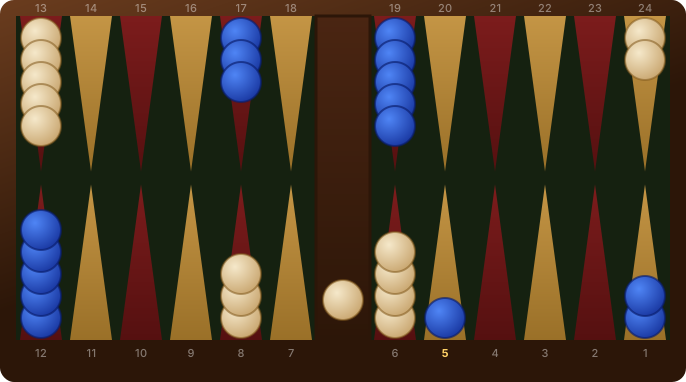
A lone checker on a point is called a blot. If your opponent lands on it, your checker is hit and placed on the bar in the middle of the board. Hitting is optional; you are never forced to hit, although the rules may force you to move in a way that happens to hit.
Rule 8: checkers on the bar come back in first
If you have a checker on the bar, you must bring it back into play before moving anything else. It enters in your opponent's home board, on the point matching one of your dice, as long as that point is open. If neither die gives you an open point, your whole turn is lost. The page on entering from the bar shows how often that happens against boards of different strength.
Rule 9: use as much of your roll as you legally can
You must play both numbers if there is any legal way to do it. If only one can be played, you must play it, and if either one could be played but not both, you must play the larger. You never get to pass on a roll because every option looks bad. This is the rule most often broken at kitchen tables, usually without anyone noticing.
Rule 10: bear off only when all fifteen are home
Once every one of your checkers is in your home board, you can start removing them. A 6 bears off a checker from the 6-point, a 5 from the 5-point, and so on. If you roll a number higher than your furthest checker, you bear off from the highest occupied point instead. If one of your checkers is hit while you are bearing off, you stop until it has travelled all the way home again. The page on bearing off goes through the edge cases.
How a game is won
The first player to bear off all fifteen wins one point. If the loser has not borne off a single checker, it is a gammon and worth two. If the loser still has a checker on the bar or in the winner's home board as well, it is a backgammon and worth three. That is the whole scoring system for a single game, and scoring covers how it extends to matches.
Three rules beginners get backwards
- Adding the dice into one move. Moving a single checker eight pips for 5-3 without checking that the intermediate point is open. If both the 5-away and the 3-away points are blocked, that eight-pip move is illegal.
- Stopping when the roll gets awkward. Playing one number and leaving the other because the second move would leave a blot. If the second number can be played legally, it must be.
- Moving while a checker sits on the bar. Nothing else moves until the bar is empty. A player with two checkers on the bar has to enter both before touching anything else.
What you can safely leave for later
The doubling cube changes what a game is worth, not how the checkers move, so it is fine to play your first games without it. The Crawford rule and the Jacoby rule only matter once the cube is in play. Opening theory, pip counting and the strategic game plans are about playing well rather than playing legally. Learn the ten rules until they are automatic, and the rest has somewhere to attach.
Testing yourself against a real opponent
The quickest way to make the rules automatic is to play games where an illegal move is impossible. Online the board simply will not accept a move that breaks rules 4 to 10, so every game you play reinforces the right habits rather than the household ones. On Backgammon Battles you can start as a guest and play straight away, and once the movement feels natural every rated game also tells you something the rules cannot: how well you actually played. The performance rating measures your decisions rather than your results, and the dice behind it are committed before play and checkable afterwards, so a bad night is something you can look at rather than argue about.
Start as a guest and let the board enforce the rules while you learn them.
Play backgammon freeFrequently asked questions
What are the basic rules of backgammon?
Two players each move fifteen checkers around the board in opposite directions according to the dice, hitting single opposing checkers where they can, and the first player to bring all fifteen home and bear them off wins.
How do you play backgammon in simple terms?
Roll two dice and move your checkers by those numbers, one die at a time. You cannot land on a point your opponent holds with two or more checkers, and a lone checker that gets hit starts again from the bar. Bring everything home, take it all off, and you win.
What happens when you roll doubles in backgammon?
You play the number four times instead of twice. A roll of 4-4 gives you four moves of four pips each, which you can split across up to four checkers.
Do I need to learn the doubling cube to start playing?
No. The doubling cube changes what a game is worth, not how the checkers move. You can play complete games without it and add it once the movement rules feel automatic.
Can a beginner play backgammon online without knowing every rule?
Yes. Online the board only allows legal moves, so it enforces the rules as you go, including the ones beginners most often get wrong, such as having to use both dice when you can.
© 2026 Backgammon Battles