How to start a backgammon game
To start a backgammon game, each player rolls one die. The higher number goes first, and that player moves using both dice exactly as they landed, so the first move of the game is made with the roll that decided who started. If the two dice match, both players roll again. From then on the players take turns rolling their own pair of dice.
That is the whole rule, and it takes ten seconds at a table. The rest of this page covers the parts that cause arguments: what counts as a tie, whether the winner may roll again, which agreements need making before the first die is thrown, and how the next game of a match begins.
That is the part this site is for. Every game is rated, and afterwards a computer walks back through your moves and shows you which ones actually cost you. The dice are committed before you move and verifiable after, so the only variable left in the result is you.
Play a rated game freeBefore the first roll
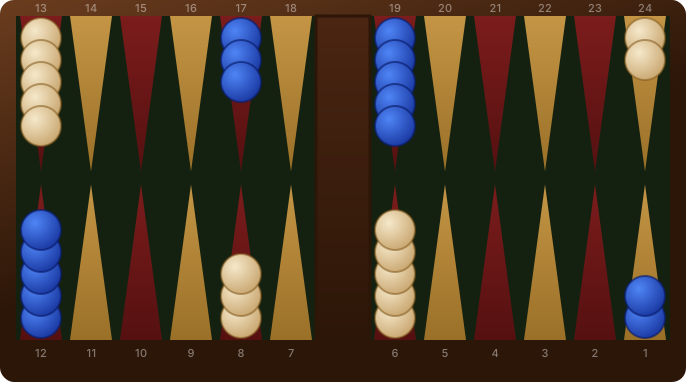
Three things need to be right before anyone rolls, because none of them can be fixed fairly once the game is under way.
- The checkers. Each side has fifteen, on four points: two on the 24-point, five on the 13-point, three on the 8-point and five on the 6-point, mirrored for the other player. Our guide on how to set up a backgammon board goes through it point by point, and the pieces and dice page covers the equipment.
- The direction. Both players should agree which way each side travels and where each home board is. Your home board is the quarter your checkers are heading for, and you bear off from there. Players sitting down at an unfamiliar board get this backwards more often than you would think.
- The cube. The doubling cube starts in the middle of the bar showing 64, which by convention means the game is worth one point and neither player owns the cube yet.
It is also the moment to agree on optional rules. In a money session that usually means whether the Jacoby rule is on and whether automatic doubles are in use. In a match it means the match length, since the Crawford rule and the score change every cube decision. Match play explains why.
The roll-off: one die each
Each player throws a single die from their own cup into the right-hand half of the board. Whoever shows the higher number wins the roll-off and moves first. A die that lands tilted against a checker, on the bar or off the board is cocked, and it is thrown again; in a tournament you wait for your opponent to agree that it is cocked before picking it up.
There is nothing to decide on this roll and no skill in it. Its only job is to settle who moves first in a way neither player controls, which is why the same fairness rules that govern every later roll apply to it.
Ties, and the automatic doubles house rule
If both dice show the same number, both players roll again, as many times as it takes for the numbers to differ. The consequence is easy to miss: the first move of a backgammon game is never a double. Every opening is two different numbers, which is exactly why opening theory deals with a fixed set of non-double rolls and has a settled answer for most of them.
Some money players add a house rule called automatic doubles. When the roll-off ties, the stakes double: the cube is turned to 2 but stays in the middle, so neither player owns it. Players usually cap it at one automatic double per game. It is a variation rather than part of the standard rules, both players have to agree to it before the session starts, and it is never used in match or tournament play. Backgammon Battles does not use it.
Playing the opening roll
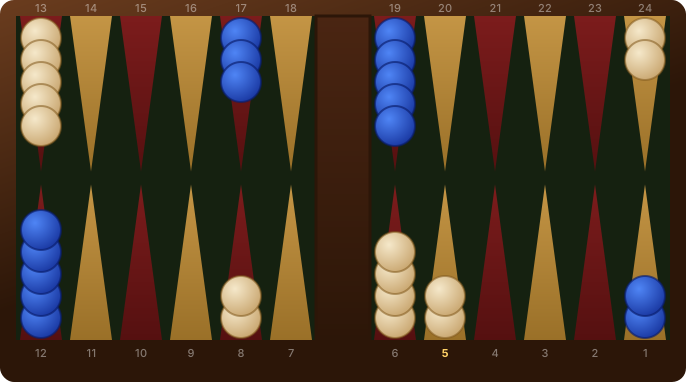
The player who won the roll-off now moves the two numbers showing, one die from each player. They do not pick the dice up and roll their own pair; the opening move is played with the roll-off itself. If you won with a 3 against a 1, your first move is a 3-1, and the strongest play is to make your 5-point.
Some casual tables let the winner of the roll-off throw both dice fresh instead. That is a house rule, and it changes the game more than it seems, because it puts doubles back into the first move. Under the standard rules the opening roll is always a non-double, and every one of those rolls has a well-studied best play. Our opening moves guide gives each one with a diagram, grouped by how settled the answer is.
After the first move: how turns work
Once the opening move is played, the other player takes the first full turn, rolling their own pair of dice and moving accordingly. From there the turns simply alternate. Each turn has a fixed order:
- If you want to double, you offer the cube before you roll, never after.
- Roll both dice from the cup into the right-hand half of the board.
- Move your checkers, using both numbers if you legally can. A double gives you four moves of that number; the doubles rules cover the details.
- Pick up your dice, which ends your turn. Until you do, you may change your move.
The last step matters more than it looks. At a tournament table the turn is over when you pick up your dice, and your opponent may not roll before that. Rolling early is the most common way new players lose a dispute they did not know they were having.
Starting the next game in a match
Matches are a series of games played to a set number of points, and every game in a tournament or online match starts with a fresh one-die roll-off. Nothing carries over from the previous game except the score. The cube goes back to the middle, the checkers go back to the starting position, and the player who won the last game has no claim on the first move of the next.
Some older home rulebooks say the winner of the previous game starts the next one. That convention still turns up at kitchen tables. Neither version is wrong at home as long as both players know which one they are using, but if you are practising for tournaments or online play, use the roll-off every game.
Mistakes people make in the first minute
- Rolling both dice to decide who starts. The roll-off is one die each. Rolling a pair each and comparing totals is a different custom and does not produce the opening move.
- Letting the winner reroll. Covered above. It allows doubles on the first move, which the standard game never has.
- Forgetting the cube position. A cube left showing 2 from the last game silently doubles the stakes of the next one.
- Agreeing the rules after the first disagreement. Jacoby, automatic doubles and match length are all easy to settle before the first roll and all hard to settle afterwards.
How a game starts online
Online, the board is set up for you and the roll-off happens on the server. On Backgammon Battles each player's opening die is drawn from the game's random seed, which the server commits to before play, so the roll that decides who goes first is as checkable as every roll after it. Ties are rolled again exactly as at a table, the winner moves with both dice, and the whole sequence can be replayed from your game history. For correspondence games, where players move a day at a time, the server resolves the roll-off from the same committed seed so neither player has to wait a day just to find out who starts. How the dice are proven fair explains the commitment step.
Does going first matter?
A little, and far less than it feels like when your opponent opens with a 3-1. Analysis by strong backgammon programs puts the edge from moving first at a small one, nowhere near enough to decide a game. Over a single game the dice swamp it. Over a few dozen games it washes out entirely, because you win the roll-off about as often as you lose it.
That is the useful way to think about luck in backgammon generally. Who went first, who rolled the doubles and who hit the last shot all matter in one game and almost not at all across many. What stays is how well you played the rolls you got, which is what a performance rating measures: every move compared against the best available move, whatever the dice did. If you want each game to count for something while you find out, play for Battle Bucks, which put stakes on the result without any real money involved.
Start as a guest, win or lose the roll-off on dice you can verify, and see how well you played afterwards.
Start a game freeFrequently asked questions
Who goes first in backgammon?
Each player rolls a single die. Whoever rolls the higher number goes first, and plays the two numbers showing on both dice as their opening move. The other player then takes the first full turn with their own two dice.
What happens if both players roll the same number to start?
Both players roll again until the numbers differ. That is why the first move of a backgammon game can never be a double. Some money games use an optional house rule called automatic doubles, where a tie also turns the doubling cube to 2; it must be agreed before play and is never used in match or tournament play.
Does the first player roll again after winning the opening roll?
No. Under the standard rules the winner of the roll-off moves the numbers already showing on the two single dice. Some casual players let the winner roll both dice fresh, but that is a house rule, and it changes the game because it allows a double on the first move.
Who starts the next game in a backgammon match?
In tournament and online match play every game starts with a new one-die roll-off, exactly like the first. Some home rulebooks let the winner of the previous game start the next one, so agree on it before you begin if you are playing at a table.
© 2026 Backgammon Battles