Official backgammon rules: what tournaments enforce
The official rules of backgammon are the tournament rules published by the World Backgammon Federation and, in the United States, by the US Backgammon Federation, whose in-person rules describe themselves as a concise rendition of the WBGF rules with the same intent. How the checkers move is the same at every table. What the official rules add is procedure: the order of a turn, when a move is final, and what happens after a mistake.
Who writes the official rules
Backgammon has no single governing body for every game ever played, and no rulebook that applies to a game at your kitchen table. What it has is a set of written tournament rules. The World Backgammon Federation publishes one. The US Backgammon Federation publishes its own rules for in-person play, revised for 2024 and again effective January 2025, and says they carry the same intent and interpretation as the WBGF's. Clubs and events adopt one of these, sometimes with local additions, and a tournament director rules on anything the players cannot settle.
That means the honest answer to "what are the official rules" has two parts. The movement rules, which you can read in full on our backgammon rules page, are universal. The procedural rules below are what an official rulebook adds, and the details differ between rule sets and between editions of the same rule set. When a point below depends on the edition, it says so. If you are entering a live event, read the rules it announces; that document governs, not this page.
The order of a turn
Casual players run the parts of a turn together. Tournament rules separate them, because almost every dispute comes from not knowing which stage a turn had reached.
- Decide on the cube first. A player who wants to double must do it before rolling. Once you have rolled, the chance to double on that turn is gone.
- Roll with a cup. Both dice are shaken in a cup and thrown so that they land flat on the board, to the right of the bar. A die that lands tilted against a checker, on the bar or off the board is cocked, and both dice are rolled again. Our page on backgammon pieces and dice covers the equipment rules, including precision dice and lipped cups.
- Move. Play the roll. You may pick checkers up, put them down and try different plays until you are happy with one.
- Pick up your dice. Lifting your dice ends the turn. In a clocked match, pressing the clock does the same. From that moment the move stands and the opponent's turn begins.
Two habits follow from this. Do not touch your opponent's checkers or dice during their turn, and do not touch your own checkers during theirs. If you think a die is cocked, wait for your opponent to agree before picking anything up, because the act of lifting the dice is the act of finishing a turn.
Illegal moves: the opponent decides
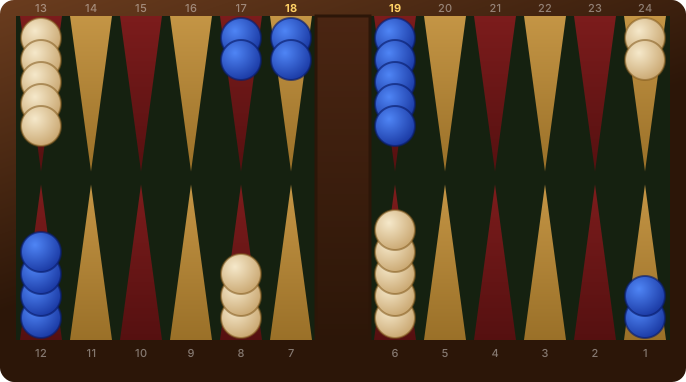
An illegal move is any play the rules do not allow: moving a single checker the full total of a roll when the intermediate point is blocked, leaving a number unplayed when it could have been played, moving while a checker sits on the bar, or bearing off before all fifteen are home. At a casual table someone usually points it out and the move is replayed. Tournament rules treat it differently.
Under the current US rules, when an illegal checker move happens, the opponent must choose: require it to be corrected, or let it stand. It is their call, not a penalty decided by the director. Older editions described the same idea as condoning: once the opponent rolls their own dice or turns the cube, the illegal move is accepted and becomes part of the game. The current rules also say that no other kind of infraction may be condoned, so an opponent cannot waive, for example, a roll that was invalid.
This is one reason experienced players keep a close eye on their opponent's moves, and one reason a disputed move is never fixed by quietly moving a checker back. Call the director, or agree the correction out loud before anyone rolls.
Rolling too early, and other invalid rolls
Rolling before your opponent has finished their turn is the commonest procedural slip in live play. A roll made before the opponent has picked up their dice is premature, and rule sets generally let the opponent have it rerolled rather than voiding it automatically. In a clocked match the WBGF text also lets a player whose opponent takes the dice before the turn is over pause the clock and finish their move.
Other rolls are simply invalid: a cocked die, a die that leaves the right-hand side of the board, or a roll thrown without the cup. The 2024 US revision added a practical rule: if a player objects before either die has begun to settle, the roll is invalid and is taken again. That stops a player who sees a die about to land badly from leaving the table to settle the argument afterwards.
When the board was set up wrong
Sooner or later someone notices, mid-game, that a checker started on the wrong point. Under the current US rules a setup error must be corrected if it is noticed before the third valid roll of the game, and the move made with the last valid roll may be replayed. After that it can be corrected only if both players agree. Older US rules allowed until the fifth roll and then made the existing setup official, and they added that a player who started with fewer than fifteen checkers in play can still be gammoned or backgammoned. If you want to avoid the problem entirely, the board setup page has a way to check your position before the first roll.
The doubling cube under official rules
The cube is where tournament rules get strict, because an offer to double is a decision your opponent has to respond to. Under the current US rules, a player who touches the cube, or makes a statement or gesture that reasonably implies they mean to double, must double at that moment, or on their next turn if doubling is not legal yet. Merely reaching towards the cube is not enough on its own. In practice this means you should not pick the cube up to think about it.
The rest of the cube rules are the standard ones. The cube starts in the middle, either player may make the first double, after that only the player who owns the cube may double, and a pass ends the game at the current value. In match play the Crawford rule applies: in the first game after one player comes within one point of winning, nobody may double.
Mixing the dice
Either player may ask to mix the dice before a game, so that neither knows which die came from which set. In the current US procedure the player who asked rolls all four dice, the opponent chooses one, and the two players then take turns choosing until each has a pair. Older editions used a fixed order in which the roller took the last die. Either way, the point is the same: no player chooses all of their own dice.
Clocks
Larger events often play with clocks, which are a separate part of the rules. A typical arrangement gives each player a reserve of time for the match plus a short delay on every move that does not count against the reserve. A player who runs out of reserve time loses the match, which is why tournament players learn to press the clock as part of picking up the dice. The exact reserve and delay are set by each event, so check the announced settings before you sit down.
What is not an official rule
Several rules that people learned at home are not part of tournament backgammon at all. They are optional agreements for money play, settled before anyone rolls, and they never apply in match play.
- Automatic doubles. Turning the cube to 2 when the opening dice tie. A money-play agreement, usually with a cap.
- Beavers. Taking a double and immediately redoubling while keeping the cube. Money play only.
- The Jacoby rule. Gammons count only once the cube has been turned. Common in money games, never in matches.
- The previous winner goes first. A household custom. Every game, including every game of a match, starts with a fresh opening roll, as explained in how to start a backgammon game.
Why the official rules exist, and what replaces them online
Read the official rules end to end and a pattern appears. Almost none of them are about strategy. They exist because two people sharing a physical board can disagree about what happened: whether a die was cocked, whether a turn was finished, whether a checker started on the right point, whether a hand moving towards the cube was an offer. The rulebook settles those disputes in advance so that the only thing left to argue about is the play.
Online, most of that procedure is unnecessary. The board will not accept an illegal move, so there is nothing to condone. The setup is placed by the software, a turn ends when you confirm it, and the cube can only be offered at the moment the rules allow. The one thing a player still has to take on trust is the dice, which is why on Backgammon Battles every roll comes from a seed the server commits to before play and you can check afterwards. Our page on provably fair dice shows how to verify a game yourself.
With the procedure handled, what is left is the part the official rules were built to protect: your decisions. Every game here is rated, and after a match a computer measures how much your moves gave away, which is what a performance rating reports. If you want a game to matter, you can put Battle Bucks on it, a stake that means something without any real money changing hands.
No disputed moves, no cocked dice, nothing to call a director about. Just a rated game against a real opponent.
Play a rated game freeFrequently asked questions
Is there an official rulebook for backgammon?
There is no single rulebook for every game, but tournament play is governed by written rules. The World Backgammon Federation publishes tournament rules, and the US Backgammon Federation's in-person rules, effective January 2025, describe themselves as a concise rendition of the WBGF rules with the same intent. Individual events announce which rules they use.
What happens if a player makes an illegal move in backgammon?
Under tournament rules the opponent decides. They can require the move to be corrected or let it stand as played. Once the opponent has accepted it, for example by going on to roll, the move is part of the game.
When is a backgammon move finished?
A move is complete when the player picks up their dice, or presses the clock in a clocked match. Until then the player may rearrange their checkers. Once the dice are lifted, the move stands.
What if the board was set up wrong?
Under the current US Backgammon Federation rules, a setup error must be corrected if it is noticed before the third valid roll of the game, and can be corrected later only if both players agree. Older rule sets used a later deadline, so check which rules your event uses.
Are automatic doubles and the Jacoby rule official rules?
No. Automatic doubles, beavers and the Jacoby rule are optional agreements for money play, settled before the game starts. They are not used in match play, which is how tournaments are played.
© 2026 Backgammon Battles