Backgammon tutorial: your first game, turn by turn
The quickest way to learn backgammon is to watch one game get played. This tutorial follows the first six turns of a real game between two players, cream and blue, with a board diagram at each stage. Each turn teaches one rule, and by the end you will have seen moving with both dice, a blot, a hit, entering from the bar, doubles and a turn lost on the bar.
You do not need to memorise anything first. If you want the rules in one list afterwards, the simple rules page has the whole game in ten, and how to play backgammon covers every part of the game in order. This page is the worked example that makes those lists make sense.
That is the part this site is for. Every game is rated, and afterwards a computer walks back through your moves and shows you which ones actually cost you. The dice are committed before you move and verifiable after, so the only variable left in the result is you.
Play a rated game freeBefore we roll: what you are looking at
Each player has fifteen checkers. Cream moves from the 24-point down toward the 1-point; blue moves the opposite way around the same horseshoe. Each player numbers the points from their own side, so cream's 24-point is blue's 1-point and the other way round. That is why a move written as "24/14" means different squares of wood depending on who made it. In this tutorial every move is written from the mover's own side, the way backgammon notation always writes it, while the diagrams always show cream's numbering.
The goal is to bring all fifteen of your checkers into your home board, the last six points of the journey, and then bear them off. Whoever gets all fifteen off first wins. The diagrams start from the standard position; the setup guide walks through it point by point if you are using a physical board.
Turn 1: cream opens with 3-1
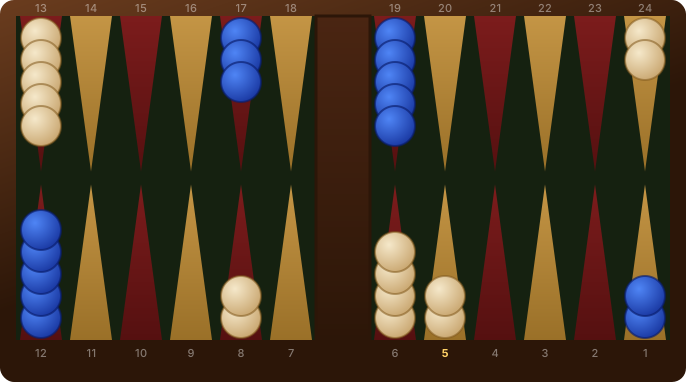
Each player rolls one die and the higher number moves first, using both of those dice as the opening roll. Cream rolled a 3 and blue a 1, so cream plays 3-1. How to start a backgammon game covers ties and the other details of the roll-off.
Cream plays 8/5 6/5: one checker from the 8-point moves three pips to the 5-point, and one from the 6-point moves one pip to join it. Two checkers on one point make that point, and a made point is safe. Your opponent cannot land on it, and a checker of theirs that would have to stop there is blocked.
The 5-point is the most valuable point to make early, because it sits in the middle of your home board and blocks your opponent's back checkers. It is one of the few opening plays that every strong player agrees on. The 3-1 opening explains why.
Turn 2: blue rolls 6-4 and runs
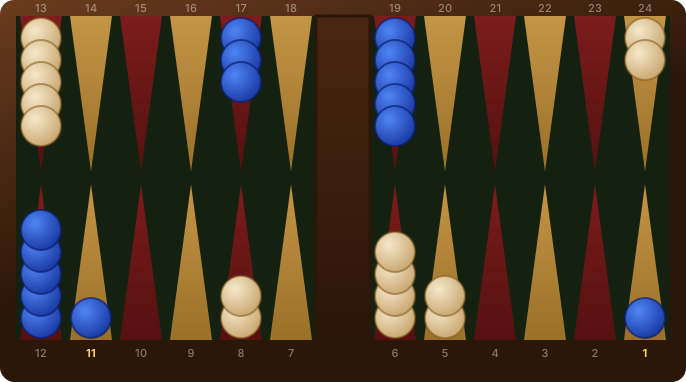
Blue plays 24/14, taking one back checker sixteen pips forward in one go. Both dice can be used by the same checker, but it has to stop on the first number along the way. Here that matters: blue cannot play the 4 first, because four pips from blue's 24-point is blue's 20-point, which is cream's freshly made 5-point. So blue plays the 6 first, stopping on its 18-point, then the 4 to its 14-point.
That leaves blue with two blots, which is the word for a point holding a single checker. A blot can be hit. One is the runner, now sitting on what cream calls the 11-point. The other is the back checker left behind on cream's 1-point. Running with 6-4 is a standard reply here, but it is not the only one: 24/18 13/9 and 8/2 6/2 are both played by strong players, the computer evaluations between the three are close, and which is best can depend on the match score. What a blot is covers when leaving one is worth the risk.
Turn 3: cream rolls 6-2 and hits
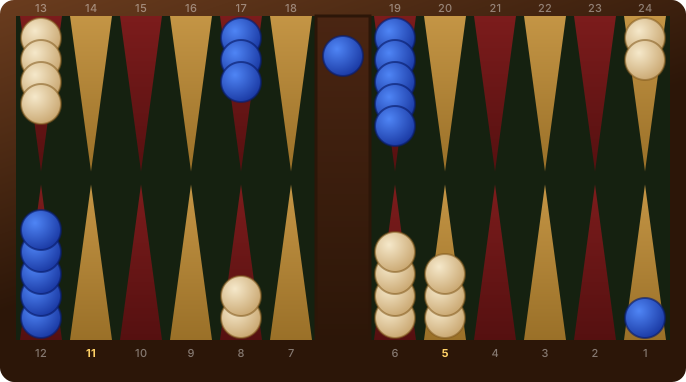
Cream plays 13/11*/5. The 2 takes a checker from the 13-point to the 11-point, landing on blue's blot. The asterisk means a hit: the blue checker is picked up and placed on the bar, the strip down the middle of the board. The 6 then carries the same cream checker on to the 5-point, where it is safe.
Hitting costs your opponent more than it looks. The checker on the bar has to start its whole journey again from the beginning, and until it comes back in, blue cannot move anything else. That second rule is what makes a strong home board so powerful.
The play also leaves cream with nothing new exposed: the hitting checker did not stay on the 11-point where it could be hit back. A hit that ends somewhere safe is one of the most comfortable moves in the game.
Turn 4: blue rolls 5-3 and enters
A checker on the bar enters in the opponent's home board, on the point that matches one of the dice, counted from the far end. For blue, a 5 would enter on cream's 5-point and a 3 on cream's 3-point. A point held by two or more opposing checkers is closed. The 5-point is closed, so blue must use the 3.
Blue plays bar/22 13/8: the 3 enters on blue's 22-point, which is cream's 3-point, and the 5 brings a checker down from blue's 13-point to its 8-point. Blue could not use the 5 on the entered checker either, because five pips on from there is cream's 8-point, which cream still holds. Entering is never optional: if you can enter, you must, before anything else. Entering from the bar covers every case, including the odds of getting in against a stronger board.
Turn 5: cream rolls double 3s
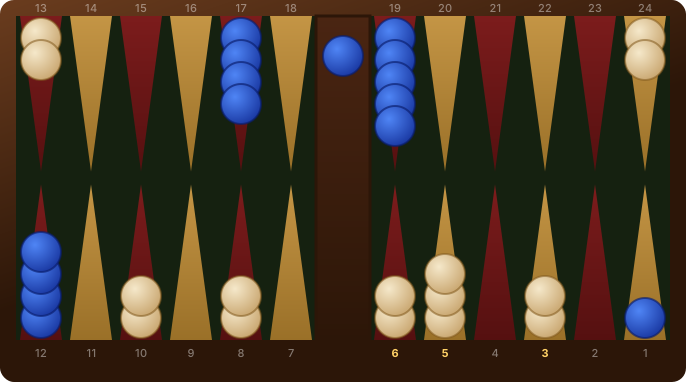
When both dice show the same number, you play that number four times instead of twice. Cream has four 3s to play and uses them as 13/10(2) 6/3*(2): two checkers from the 13-point to the 10-point, and two from the 6-point to the 3-point. The second pair lands on the blue checker that had just entered, hits it, and makes the 3-point in the same move. The "(2)" simply means the move was made by two checkers.
Look at what blue faces now. Cream holds its 6, 5 and 3 points, so three of the six entry points are shut. The new pair on the 10-point is there to build more of them. Doubles are where games swing, and the doubles rules cover the cases that cause arguments, such as when only some of the four moves can be played.
Turn 6: blue rolls 6-5 and cannot move
Blue has a checker on the bar and rolls 6-5. A 6 would enter on cream's 6-point and a 5 on cream's 5-point. Both are closed. Blue cannot enter, and because nothing else may move while a checker is on the bar, blue loses the whole turn. Players call this dancing.
This is the payoff of the last five turns. Cream did not just hit; it hit while building the points that keep the hit checker out. Every point cream adds to that board makes the next roll worse for blue. A board with all six points closed would leave blue unable to move at all until cream opened a point.
What happens in the rest of the game
From here the game moves through stages that every game shares, in some order:
- The middle game. Both sides fight for points, hit each other's blots and try to escape their back checkers. Most of the skill in backgammon lives here, in choosing between safe plays and bold ones.
- The race. Once the two armies have passed each other and no more contact is possible, it is a pure race. Knowing who is ahead means counting pips, which the pip count guide teaches in a few minutes.
- Bearing off. When all fifteen of your checkers are in your home board, you start removing them. If a checker of yours is hit during this stage, it must come all the way home again before you bear off another. Bearing off covers the rule about high numbers that beginners most often get wrong.
- Winning. The first player to bear off all fifteen wins a single game. If the loser has not borne off any checkers, that is a gammon and counts double. Scoring explains gammons, backgammons and how points add up in a match.
There is also the doubling cube, which lets either player raise the stakes before their roll. You can play your first few games without it. When you are ready, the doubling cube guide explains it in plain terms.
What this game teaches about learning
Notice what decided the six turns above. Blue did nothing obviously wrong, and cream's rolls were good: a 6-2 that hit and a double that hit again. That is backgammon. Over one game, the dice can make a sound player look foolish and a careless one look clever, which is why judging yourself by wins and losses is so misleading for the first few dozen games.
What you can judge is the quality of each decision. After every game on Backgammon Battles, a computer reviews every move you made against the best move available and marks the ones that cost you. Those marks add up to a performance rating, a measure of how well you played the rolls you got, whatever the dice did. If you want to know whether the rolls themselves were fair, every roll is committed before you move and verifiable afterward.
Start as a guest, play a full game against a person or the practice bot, and see afterward which of your moves the computer would have played differently.
Play your first game freeFrequently asked questions
What is the fastest way to learn backgammon?
Learn the movement rules from one worked game, then play. The rules fit on a page, but they only make sense once you have seen a checker hit, sent to the bar and brought back in. After a few games, review them with a computer so you learn which of your moves actually cost you, rather than guessing from whether you won.
Can you move one checker with both dice in backgammon?
Yes. The two dice are two separate moves, and you may play both with the same checker, but the checker has to stop on the first number along the way. That stopping point must not be held by two or more opposing checkers, or the combined move is not allowed in that order.
What happens when you cannot enter from the bar?
You lose the whole turn. A checker on the bar must come back in before you move anything else, and it can only enter on a point in your opponent's home board that matches one of your dice and is not held by two or more of their checkers. If neither number gives you a legal entry point, you pass and your opponent rolls.
How long does it take to get good at backgammon?
You can play a complete, legal game in an evening. Getting good is a different question, and the honest way to answer it is to measure it: a performance rating grades every decision you make against the best available play, so you can see whether you are improving over weeks rather than relying on a few lucky or unlucky results.
© 2026 Backgammon Battles